
Close 2023

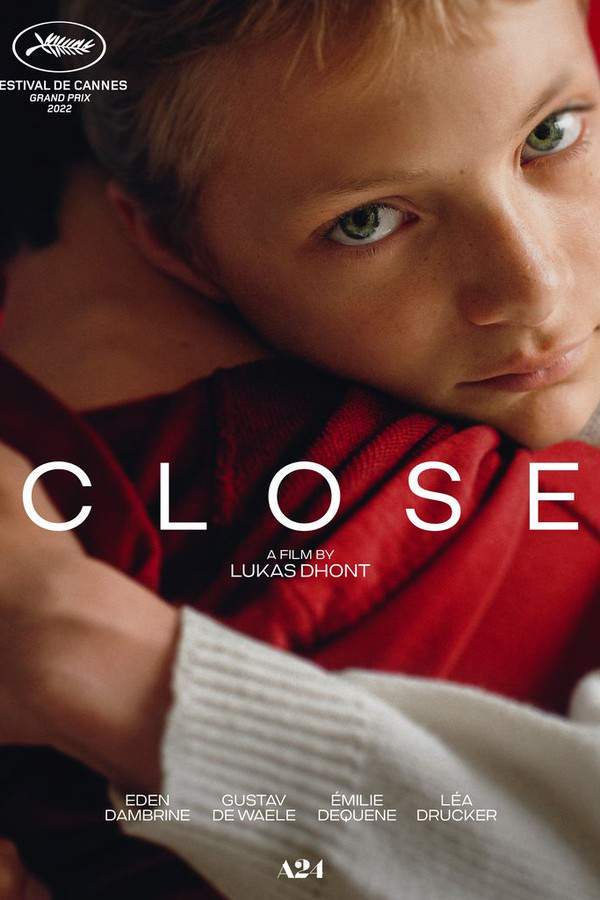
The intense and emotional story follows Leo and Remi, two close friends on the cusp of adolescence. Their seemingly unbreakable bond is tested as they confront difficult truths and experience a painful separation. The film explores themes of friendship, identity, and the challenges of growing up, portraying a raw and intimate portrayal of loss and the search for healing and understanding.


Does Close have end credit scenes?
No!
Close does not have end credit scenes. You can leave when the credits roll.
Meet the Full Cast and Actors of Close
Explore the complete cast of Close, including both lead and supporting actors. Learn who plays each character, discover their past roles and achievements, and find out what makes this ensemble cast stand out in the world of film and television.

Ahlaam Teghadouini
Colleague Sophie
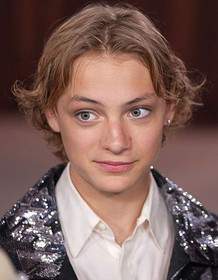
Eden Dambrine
Leo

Elodie Barthels

Émilie Dequenne
Sophie

Gustav De Waele
Remi

Hélène Theunissen
Denise
Herman van Slambrouck
Mark

Igor van Dessel
Charlie

Kevin Janssens
Peter

Léa Drucker
Nathalie

Léon Bataille
Baptiste

Marc Weiss
Yves

Robin Keyaert
Thomas

Serine Ayari
Céline
External Links and Streaming Options
Discover where to watch Close online, including streaming platforms, rental options, and official sources. Compare reviews, ratings, and in-depth movie information across sites like IMDb, TMDb, Wikipedia or Rotten Tomatoes.










Ratings and Reviews for Close
See how Close is rated across major platforms like IMDb, Metacritic, and TMDb. Compare audience scores and critic reviews to understand where Close stands among top-rated movies in its genre.

The Movie Echo Score
Close succeeds through its deeply felt performances and meticulously crafted visual world, establishing an emotionally resonant portrait of adolescent friendship. Critics highlight the film’s masterful direction, claustrophobic cinematography, and stirring score that immerse the viewer in a finely detailed setting. While the narrative occasionally leans on heavy-handed symbolism and a formulaic emotional arc, the cumulative effect remains poignant and thought‑provoking. Consequently, the film offers a compelling, if demanding, experience that lingers beyond its runtime.
The Movie Echo Score Breakdown for Close

Art & Craft
In terms of direction and cinematography, Close presents a meticulously composed visual palette, with claustrophobic framing and elegant seasonal symbolism that reinforce the story’s emotional tone. Critics note the production design’s subtle realism and the director’s patient handling of young performers. Minor criticisms mention a lack of innovative visual risk, yet the overall craft remains compelling.

Character & Emotion
When evaluating character work, the film’s leads deliver nuanced, emotionally charged performances that anchor the narrative’s intimacy. Reviewers commend the natural chemistry between the young actors and the depth of their non‑verbal expression. Some viewers, however, perceive moments of over‑sentimentality that strain authenticity, though the overall acting remains a standout element.

Story & Flow
The story follows two boys navigating friendship amid societal prejudice, employing a measured pacing that oscillates between tender moments and escalating tension. Critics appreciate its avoidance of typical clichés yet criticize occasional heavy‑handed symbolism and a formulaic emotional crescendo. While the narrative’s core remains engaging, its reliance on overt melodrama can diminish narrative subtlety.

Sensory Experience
Close’s sensory layer combines a plaintive score by Valentin Hadjadj with restrained sound design, enhancing the film’s emotional undercurrents. Visuals feature subdued lighting and tight framing that create an intimate, tactile atmosphere praised by critics. Though some audience members find the sensory intensity overwhelming, the overall auditory‑visual synthesis supports the film’s thematic intent.

Rewatch Factor
The film’s rewatch value stems from its potent emotional core and striking visual storytelling, encouraging viewers to revisit nuanced performances and subtle cues. While its heavy thematic weight may deter casual repeat viewings, many critics and audiences note that the layered portrayal of friendship rewards subsequent screenings. Overall, the film maintains a lasting appeal for attentive viewers.

81
Metascore
7.8
User Score


91%
TOMATOMETER

89%
User Score

7.8 /10
IMDb Rating

78
%
User Score

4.1
From 14K fan ratings

4.43/5
From 7 fan ratings
Take the Ultimate Close Movie Quiz
Challenge your knowledge of Close with this fun and interactive movie quiz. Test yourself on key plot points, iconic characters, hidden details, and memorable moments to see how well you really know the film.
Close (2023) Quiz: Test your knowledge of the film Close (2023) with these ten questions covering characters, plot points, and themes.
What are the names of the two 13‑year‑old best friends in the film?
Awards & Nominations for Close
Discover all the awards and nominations received by Close, from Oscars to film festival honors. Learn how Close and its cast and crew have been recognized by critics and the industry alike.
Full Plot Summary and Ending Explained for Close
Read the complete plot summary of Close, including all major events, twists, and the full ending explained in detail. Explore key characters, themes, hidden meanings, and everything you need to understand the story from beginning to end.
In rural Belgium, two 13-year-old boys, Léo Eden Dambrine and Rémi Gustav De Waele, share a bond that feels deeply intimate for their age, a closeness that colors every day they spend together. They have a quiet routine of sleeping in the same bed in Rémi’s bedroom, a detail their families receive with warmth and without judgment; Sophie Émilie Dequenne and Peter Kevin Janssens love Léo like a second child, while Léo’s family helps run a flower farm where the boys freely roam, play, and drift between work and imagination among the blooms. The setting—sunlit fields, the hum of bees, the steady cadence of farm life—shapes the ordinary space where their friendship grows.
At school, a trio of female classmates openly asks if the two are a couple, and Léo answers with a firm denial while Rémi stays quiet, leaving the question hovering in the air. The moment makes Léo uneasy, a sign of how external perceptions press in and threaten the safety of their bond. Soon he faces harsh, homophobic slurs from other boys, a reminder that their closeness may not be accepted beyond the privacy of home. Fearing ostracism more than the truth of his feelings, Léo begins to seek new friendships and even takes up ice hockey, an activity that keeps him busy and away from Rémi, a deliberate distancing that unsettles both of them. The once-easy companionship thins as Léo’s world widens in ways that do not include Rémi.
One night, during a sleepover at Rémi’s, Léo decides to sleep on a separate mattress. When he wakes, he finds Rémi sharing the same bed still, and a rush of confusion and anger erupts into aggression that leaves Rémi hurt and bewildered. From that moment, Léo grows more distant, resuming solitary routines, riding his bicycle with classmates other than Rémi, continuing ice hockey, and spending more time helping his family on the farm. Rémi confronts him in vain, and the tension flares into a brief, painful fight between the two friends. The depth of their connection now sits at risk, hidden behind a wall of misunderstanding and fear.
The school trip that Rémi misses becomes a turning point: the class returns with news that Rémi has killed himself. Léo confronts the catastrophe with a gravity that he cannot fully show; he believes his withdrawal and his inability to respond to Rémi’s needs contributed to the tragedy, and the weight of that belief tugs at him in every moment. Yet he closes himself off, unable to grieve openly during the class therapy sessions offered by the school. The obituaries paint Rémi as a happy, friendly boy, a portrayal that one by one sparks a defiant response in Léo—an insistence on grappling with the truth of his pain rather than accepting the glossy version the world offers.
In the months that follow, Léo tries to mask his sorrow through routine: ice hockey, tending the garden, and the endless repetition of farm chores. Still, none of his new friendships offers the same shelter or clarity he once found with Rémi. He does find solace in confiding, gradually, in his older brother Charlie Igor van Dessel, whose presence offers a quieter form of comfort and a mirror for Léo’s fear and longing. Charlie’s support becomes a crucial anchor as the family navigates grief from a distance, while Sophie Émilie Dequenne and Peter Kevin Janssens grapple with their own sorrow and the sense of a future that Rémi’s absence has forever altered.
After Rémi’s funeral, Léo feels a pressing need to speak with Sophie, hoping to maintain a thread of connection with the family even as the world shifts around them. During a dinner that brings Sophie and Peter to Léo’s home, the moment deepens as Charlie speaks about his own future plans, and Sophie and Peter confront the stark reality of a boy who will never grow up into those possibilities. The conversation carries an ache that lingers, a reminder of the fragility of youth and the heavy burden of unspoken grief.
When summer arrives and Léo visits Sophie at her workplace, a slow, uneasy drive home becomes the catalyst for confession: he tells Sophie that he believes Rémi’s suicide was his fault for pushing him away. The revelation comes with a tremor of fear, but it is met with a gentle, healing moment as Sophie holds him and they cry together, allowing the shared pain to begin to loosen its grip. In the months that follow, Sophie and Peter move away, leaving the house empty and the fields silent in a way they were not before. In the final quiet of the field where Léo and Rémi once ran together, Léo walks through the memory of their friendship and allows himself to grieve at last, acknowledging the depth of what they shared and the accident of time that kept them apart.
This is a story of a fragile, formative bond under pressure, of the brutal ache of loss, and of the slow, painstaking process of learning to bear the weight of guilt while honoring the lasting memory of a friend who helped define who Léo becomes.

Watch Trailers, Clips & Behind-the-Scenes for Close
Watch official trailers, exclusive clips, cast interviews, and behind-the-scenes footage from Close. Dive deeper into the making of the film, its standout moments, and key production insights.
Close Themes and Keywords
Discover the central themes, ideas, and keywords that define the movie’s story, tone, and message. Analyze the film’s deeper meanings, genre influences, and recurring concepts.
Close Other Names and Titles
Explore the various alternative titles, translations, and other names used for Close across different regions and languages. Understand how the film is marketed and recognized worldwide.
Similar Movies To Close You Should Know About
Browse a curated list of movies similar in genre, tone, characters, or story structure. Discover new titles like the one you're watching, perfect for fans of related plots, vibes, or cinematic styles.





Quick Links: Summary, Cast, Ratings, More

What's After the Movie?
Not sure whether to stay after the credits? Find out!




Explore Our Movie Platform
New Movie Releases (2026)
Famous Movie Actors
Top Film Production Studios
Movie Plot Summaries & Endings
Major Movie Awards & Winners
Best Concert Films & Music Documentaries
Movie Collections and Curated Lists
© 2026 What's After the Movie. All rights reserved.