
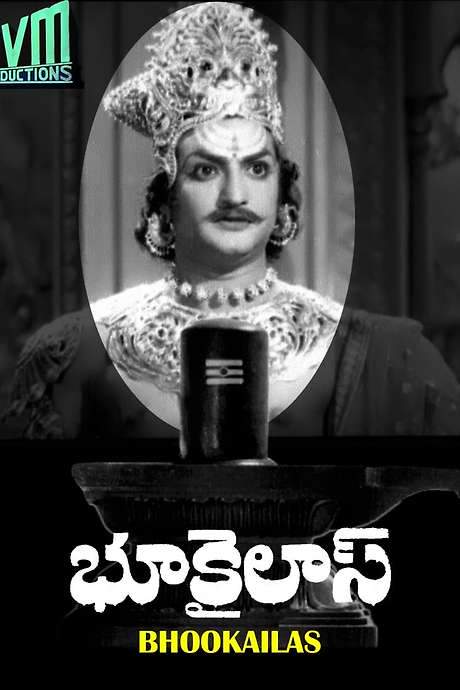



Bhookailas Plot Summary
Read the complete plot summary and ending explained for Bhookailas (1958). From turning points to emotional moments, uncover what really happened and why it matters.
Opening in Lanka, Narada Maharshi, Nageshwara Rao Akkineni, reports to Indra that Ravana’s power stems from a deep devotion to his mother Kaikashi. Kaikashi herself keeps daily worship at the forefront, honoring Saikathalingam, a sand-carved Siva on the seashore. Indra sabotages her prayers, and Ravana pledges to gift the Atmalingam, the Lord’s soul, to her as he undertakes a rigorous penance.
Ravana, N.T. Rama Rao, eventually meets Narada and openly shares his plan. Hearing this, Parvati, B. Saroja Devi, trembles and seeks help from Vishnu for her husband’s sake. Vishnu conjures an illusion that inflames Ravana’s desire for Parvati and grants the wish, but Parvati, aware of Vishnu’s maneuver, curses him to cry when separated from his wife.
With this, Narada feels vindicated about the Ramavatar, while Parvati transforms into Bhadrakali. Ravana is stunned when Narada warns him that Siva has approved a duplicate, so he withdraws the copy and begins a search for the original. Into this tale strides Mandodari, the daughter of Mayasura, who falls for Ravana at first sight. Narada presents Mandodari as Parvati to Ravana, and the match is set in motion.
Mayasura, S. V. Ranga Rao, initially resists the union because he is a devotee of Vishnu, whereas Ravana is his foe. Narada works to smooth the path, and soon Ravana and Mandodari are wed. Upon their return home, Kaikashi questions the Atmalingam, and Ravana recounts what happened, earning her rebuke. As Mandodari’s background comes to light, Narada’s manipulations weigh on Ravana, and guilt surfaces over the deception that shaped their bond.
Ravana then confronts remorse through a period of penance, even contemplating self-sacrifice, but Kaikashi intervenes, urging him to try again with unwavering devotion. He presses on, seeking forgiveness before the Lord, even to the point of decapitation as an act of penance.
Pleased with his resolve, Siva, Nagabhushanam, grants him the Atmalingam and instructs that it must not touch the ground until he reaches Lanka. Narada, ever the trickster, calls in Ganesha, who appears as a Brahmin boy to test Ravana. The test requires Ravana to hold the Atmalingam during the Surya ritual; the boy warns that if Ravana is not summoned thrice, the sacred object must be placed on the Earth.
Ravana is urged thrice and the Atmalingam is set down. In a fit of rage, he leaps toward Vigneswara, but Narada tempers the moment. Ravana cannot recover the Atmalingam and collapses, praying before the statue, unable to keep his word. In the end, Siva, Parvati, and Ganesha reveal that the episode occurred within a sanctum and that Ravana’s tale will endure in myth.
The film closes by showing the enduring reverence of the myth at sacred sites, with the legend associated with the Mahabaleshwar Temple and Gokarna in Karnataka continuing to be celebrated by worshippers to this day.
Bhookailas Timeline
Follow the complete movie timeline of Bhookailas (1958) with every major event in chronological order. Great for understanding complex plots and story progression.
Ravana's invasion and Narada's prophecy
The film opens with Ravana's campaign that devastates the Earth as he proclaims an invasion of Amaravati. Narada broadcasts to Indra about Ravana's power and hints at a secret devotion to his mother Kaikashi behind the might.
Kaikashi worship and Ravana's vow for the Atmalingam
Kaikashi maintains daily worship of the Saikathalingam by the sea, seeking spiritual strength. Ravana pledges to gift the Atmalingam to her and begins intense penance to obtain it. Narada, upset by Kaikashi's devotion, interferes with her prayers.
Ravana reveals his plan and Parvati seeks aid
Ravana meets Narada and reveals his plan to secure the Atmalingam. Hearing this, Parvati grows uneasy and prays to Vishnu for help to safeguard her husband’s honor. Vishnu promises aid, setting the stage for divine intervention.
Vishnu's illusion and Parvati's curse
During Ravana's penance, Shiva and Parvati reveal themselves. Vishnu crafts an illusion that makes Ravana crave Parvati. Parvati, aware of Vishnu's trick, curses him to shed tears by detaching from his wife.
Ramavatar omen and Bhadrakali emergence
Narada basks in the festival aura of Ramavatar as a sign of the expected savior. Parvati transforms into Bhadrakali to confront Ravana's arrogance. Narada reveals that Shiva has endorsed a duplicate, causing Ravana to withdraw his wife and search for the original.
Mandodari's arrival and Narada's disguise
Mandodari, Mayasura’s daughter, spots Ravana and falls for him at first sight. Narada disguises himself as Parvati to orchestrate the encounter, while Mayasura objects to the match because of his Vishnu devotion. Narada smooths the path and arranges the nuptials of Ravana and Mandodari.
Kaikashi questions Atmalingam and Narada's manipulation
Kaikashi questions the Atmalingam and learns of Mandodari’s backstory and Narada’s scheming. Ravana realizes how Narada’s manipulations have influenced him, exposing the illusion that guided his decisions. The growing tension foreshadows a reckoning.
Ravana's repentance and attempted self-sacrifice
Overwhelmed with guilt, Ravana contemplates repentance and even self-sacrifice. Kaikashi bars his attempt and urges him to try again with steadfast initiation.
Deeper penance, Atmalingam granted, and a divine test
Ravana seeks deeper penance before the Lord, and Shiva grants him Atmalingam with the warning not to place it on the ground before landing in Lanka. Narada incites Ganesha by disguising a Brahmin boy to test the ritual. Infuriated, Ravana acts rashly toward the divine test when provoked.
Ganesha's test and the thrice-call rule
Ganesha, in disguise as a Brahmin boy, sets a condition: Ravana must be called thrice or place the Atmalingam on Earth. Ravana is warned by the boy and the test proceeds, forcing him to respond to the challenge.
Ravana's reaction to the test
Infuriated, Ravana jumps onto Vigneswara (Ganesha), prompting Narada to pacify the god. The divine encounter continues as the test unfolds and the path to the ultimate outcome remains uncertain.
The sacred sanction and immortality of the tale
Ravana struggles to re-extract the Atmalingam but fails and collapses before the sacred statue, unable to keep his word. Shiva appears with Parvati and Ganesha, declaring that the idolatry occurred within a sanctum and that Ravana's story will be immortal.
The enduring shrine: Mahabaleshwar Temple
The film closes by showing the place the public adores as Mahabaleshwar Temple, in Gokarna, Karnataka, still revered today. The legend underscores Ravana's devotion and the Atmalingam's fate as part of living tradition.
Bhookailas Characters
Explore all characters from Bhookailas (1958). Get detailed profiles with their roles, arcs, and key relationships explained.
Narada Maharshi
A cunning sage who orchestrates divine schemes and stirs events from the shadows. He peddles news to Indra, uses illusion to influence mortals and gods, and relishes the role of a provocateur. His scheming sets the plot in motion and reveals how mischief can alter the course of fate.
Ravana (Ravanudu)
A powerful king of Lanka whose ambition and pride drive him to seek the Atmalingam. He endures intense penance and wields immense authority, yet is vulnerable to desire and misjudgment. His arc moves from fervent devotion and defiance to repentance, ending in a fatal confrontation with cosmic order.
Parvati
Goddess and wife of Shiva, she navigates the divine schemes surrounding Ravana’s penance. She reveals both compassion and resolve, cursing Vishnu to feel sorrow when misused by beauty and illusion. Parvati eventually embodies Bhadrakali, asserting cosmic balance and guiding events toward dharma.
Shiva
Lord Siva participates in the divine drama, granting Atmalingam under conditions and overseeing the moral tests of devotion. He appears with Parvati and Ganesh, embodying the delicate balance between mercy and justice that governs cosmic order.
Mandodari
Daughter of Mayasura, she is drawn to Ravana and becomes a focal point of Narada's manipulations. Her attraction and loyalties are tested as deception and desire weave through the royal match.
Mayasura
King of Patala and a cautious, pragmatic ruler who navigates alliances and divine scrutiny. His role as a father-in-law figure adds a layer of political intrigue to the tale.
Bhookailas Settings
Learn where and when Bhookailas (1958) takes place. Explore the film’s settings, era, and how they shape the narrative.
Time period
Ancient mythological era
Set in a timeless, mythic past where gods and demons contest dharma. Penance, illusion, and divine interventions drive the plot more than historical dates. The events traverse celestial and mortal realms, reflecting timeless spiritual themes.
Location
Lanka, Amaravati, Patala, Mahabaleshwar Temple, Gokarna
The tale unfolds across Lanka, Ravana's formidable empire, and the celestial city of Amaravati. Patala, ruled by Mayasura, is a shadowy realm that intersects mortal and divine affairs. The narrative also visits sacred Karnataka sites, with the Mahabaleshwar Temple in Gokarna anchoring the story in enduring pilgrimage.
Bhookailas Themes
Discover the main themes in Bhookailas (1958). Analyze the deeper meanings, emotional layers, and social commentary behind the film.
🕉️
Devotion vs Deception
Ravana's unwavering devotion to his mother Kaikashi and his extreme penance set him on a path toward divine favor. However, Narada's tricks reveal how devotion can be weaponized to serve ambition. Parvati's responses show that even gods engage with human motives and test loyalties. The clash between genuine piety and manipulation drives the film's moral tension.
🔥
Penance and Fate
Ravana's rigorous penance to win Siva's grace becomes a catalyst for his rise and fall. The Atmalingam rite is a test of restraint and obedience, with the gods shaping events to probe his character. Illusions and divine tests—when Narada and Ganesha interfere—reveal the fragility of desire against cosmic order. His later act of repentance shifts the narrative toward mercy and consequence.
⚖️
Dharma and Consequence
The story pits personal ambition against cosmic order. Vishnu's playful deceit and Parvati's mourning explore the complexities of dharma and mercy. Ravana's ultimate death and his moments of remorse demonstrate how hubris invites consequences, but there is room for redemption. The film frames moral choices as happenings across realms, not just battles.
🎭
Masks and Identity
Narada's impersonation of Parvati to win Mandodari for Ravana shows how appearances can deceive and destabilize loyalties. Mandodari's attraction and the ensuing wedding test loyalty and discernment. Parvati's transformation into Bhadrakali and the eventual revelation remind viewers that divine identities can be hidden and revealed. The tale underscores the fragility of surface identities in a world ruled by gods and sages.

Bhookailas Spoiler-Free Summary
Discover the spoiler-free summary of Bhookailas (1958). Get a concise overview without any spoilers.
In a world where the mortal realm brushes against the divine, the film opens on the legendary island of Lanka and the sacred shorelines of Gokarna, places steeped in ancient pilgrimage and mythic reverence. The atmosphere is richly textured with temple bells, ocean‑breezed chants, and the ever‑present sense that every action reverberates through a larger cosmic tapestry. This setting, bathed in warm golds and deep indigos, invites the audience into a story that feels both timeless and intimately grounded in Karnataka’s living folklore.
At the heart of the tale stands Narada, the mischievous sage whose celestial gossip sets the wheels of destiny turning. Beside him, Ravana, a formidable king whose power is matched only by the depth of his devotion, grapples with the expectations of his lineage and the yearning for divine favor. Parvati appears as a luminous presence whose compassion and resolve weave through the lives of gods and men alike, while Vishnu watches from his lofty throne, ready to intervene in subtle, often playful ways. The narrative also introduces Mandodari, a figure of striking beauty and mystery, whose connection to the earth‑bound craftsman Mayasura adds another layer of intrigue to the unfolding drama.
The film balances grand, mythic spectacle with intimate character moments, creating a tone that is both reverent and surprisingly human. As divine beings converse and mortals wrestle with their aspirations, a subtle contest of faith, honor, and love begins to surface. Each character is drawn into a delicate dance of promises and expectations, hinting at trials that will test their resolve without yet revealing the nature of those challenges.
Through vivid visuals, lyrical music, and a storytelling style that feels like a living oral tradition, the movie beckons viewers to step into a world where devotion can move mountains and where the line between legend and lived experience is perpetually blurred. The journey promises both awe‑inspiring wonder and the quiet intensity of personal sacrifice, leaving the audience eager to see how these ancient forces will shape the destinies of those who dare to seek them.
Featured on this page

What's After the Movie?
Not sure whether to stay after the credits? Find out!




Explore Our Movie Platform
New Movie Releases (2025)
Famous Movie Actors
Top Film Production Studios
Movie Plot Summaries & Endings
Major Movie Awards & Winners
Best Concert Films & Music Documentaries
Movie Collections and Curated Lists
© 2025 What's After the Movie. All rights reserved.