
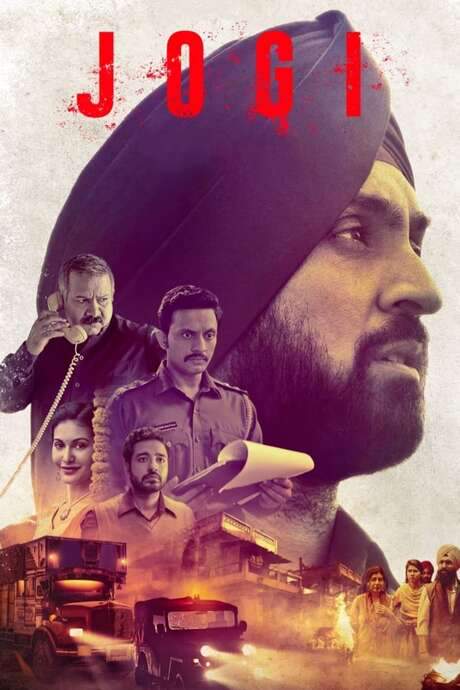



Jogi Plot Summary
Read the complete plot summary and ending explained for Jogi (2022). From turning points to emotional moments, uncover what really happened and why it matters.
Set in Delhi’s eastside Trilokpuri, this film traces a three-day window in the immediate aftermath of Indira Gandhi’s assassination on 31 October 1984, four months after Operation Blue Star. At its core are the stories of a traditional, working‑class Sikh family spanning three generations, who begin their day with the familiar rhythms: the kids headed for school, the women frying parathas, and the elders sharing quiet jokes around the breakfast table. They have no idea the world is about to transform around them.
As the morning progresses and news of the assassination spreads, the family’s ordinary routine is shattered. On a bus ride to work, they become targets as tensions flare; a questions of fate becomes a cruel chant: “what is our fault?”—to which the cruel reply is simply, “you are a sardar.” > “you are a sardar.” The film moves through a harrowing three days of escalating violence, where Sikhs are scapegoated and identified by their distinct appearances and the names on electoral registers, a dangerous incitement amplified by Tejpal Arora.
The upheaval does not spare Jogi’s family. Sukhi, Jogi’s elder brother, is beaten as he opens his shop and is burned alive along with others, leaving Heer and the rest of the family to navigate shock and grief. Mobs pour through the streets, buildings burn, and a tormented scene shows a man in a turban running on fire, while a Sikh family is enveloped in flames inside a car. When Jogi returns home, he finds an emptied house; neighbors are even cutting their children’s hair in a desperate bid to disappear from sight. At his sister Heer’s home, he finds Sukhi and other relatives gathered around her sewing machine, stitching a shirt for her dead husband, a moment that tightens the family’s resolve. Jogi consoles his sister, and Sukhi, already overwhelmed by grief, breaks down.
In the midst of this crisis, Rawinder Chautala, Rawinder Chautala, a friend and police officer, spots Jogi’s family name on a target list and urges him to flee to Punjab. Yet Jogi makes a vow that extends beyond his own kin: he intends to stand with his entire Sikh community. After a deeply emotional moment in which he cuts his hair, Rawinder and [Kareem] helps him begin a plan. The group works to relocate Sikhs by transporting them in a truck masked as a weapon- and alcohol‑haul vehicle, guiding them toward safety in Punjab.
A brief flashback sheds light on Laali’s vendetta with Jogi, centering on Kammo’s suicide and the unresolved ties that fuel old wounds. The film closes with a poignant, if contradictory, arc: the community seems saved when the Indian Army arrives—courtesy of Laali’s intervention—but Jogi is fatally shot by Tejpal Arora in a final, heartrending moment that underscores the costs of violence and the fragility of peace.
The narrative is anchored by intimate, human scenes—between father and son on the bus, siblings sharing grief, neighbors wondering how to survive—and expanded by the sweeping, turbulent backdrop of a city under siege. The characters feel vividly real as their personal losses intersect with political and communal forces, and the film never loses sight of the everyday courage it takes to endure, persevere, and hope amid catastrophe. The story lingers on the moral choices people make when fear, loyalty, and justice collide, inviting viewers to witness not just tragedy, but the stubborn human drive toward resilience and unity.
Jogi Timeline
Follow the complete movie timeline of Jogi (2022) with every major event in chronological order. Great for understanding complex plots and story progression.
Normal morning in Trilokpuri
In the Delhi neighborhood of Trilokpuri, Jogi's traditional working-class Sikh family begins a routine morning. The children hurry to school, women fry parathas, and the elders chat at the table. They are unaware that a catastrophe is about to unfold elsewhere in the city.
Assassination shocks the commute
On the bus to work with his father, Jogi hears news that Indira Gandhi has been assassinated. A crowd suddenly turns hostile as the news spreads, and men beat Jogi and his father. The father asks, 'what is our fault?', and a bystander replies, 'you are a sardar'.
Three days of anti-Sikh violence
In the immediate aftermath, Sikhs become scapegoats as violence erupts across the area. Mobs target people by appearance and by name on the electoral register, with political manipulation by local MLA Tejpal Arora fanning the hostility. The community endures beatings, arson, and dire fates as shops are burned and families driven from their homes.
Brother-in-law attacked and shop burned
Jogi's brother-in-law is beaten as he opens his shop and is burned alive, a brutal display of the violence plaguing the community. The violence spreads through the streets as more Sikh-owned businesses are attacked. The fear deepens as the city seems to descend into chaos.
Violence escalates to horrific scenes
Across the streets, mobs chase Sikhs; a man in a turban is shown running while on fire, crying for help. A Sikh family is burned inside a car, a stark image of the brutality facing the community. The city gridlocks as fear replaces routine life.
Home becomes hollow; family scatters to survive
Jogi returns to an empty house, finding neighbors cutting their children's hair to hide their identities. The ritual underscores the communal effort to survive the mob violence. The scene marks a turning point as fear pushes families to take drastic measures.
Sukhi and Heer mourn the loss
At his sister's house, Sukhi and other relatives sit in shock while Heer stitches a shirt for her dead husband. Jogi consoles his sister, sharing the weight of a family torn apart. Sukhi's heartbreak reveals the personal toll of the violence.
Police warning and a choice to flee
Rawinder Chautala, a friend and police officer, spots Jogi's family name on the target list and urges him to leave for Punjab. Despite the danger, Jogi commits to protecting not just his family but the entire Sikh community. The tension between duty and family loyalty drives his resolve.
A vow to protect the community; hair becomes symbol
In a decisive moment, Jogi vows to help the entire Sikh community beyond his kin. In an intensely emotional act, he cuts his long hair, signaling a willingness to take personal risks for others. Rawinder and Kareem stand by him as partners in this dangerous mission.
Disguised transport to safety
Rawinder and Kareem help split the Sikhs into groups and load them into a truck disguised as a weapon and alcohol vehicle to ferry them toward Punjab. The operation is clandestine, reflecting the urgency to save lives under threat. The plan marks a move from denial to structured evacuation.
First round of evacuations begins
The truck convoy carries the first round of Sikhs to Punjab, one by one, as the hidden convoy slips past mobs. The operation demonstrates both desperation and courage as families cling to hope of safety. The makeshift evacuation underscores the peril of staying in Delhi.
Flashback: Laali's vendetta resurfaces
A brief flashback reveals Laali's vendetta against Jogi stemming from Kamo's suicide. The memory haunts Jogi and foreshadows tensions that may shape the present danger. The backstory interlocks personal grievances with communal violence.
Army intervention and Jogi's death
Moments after the Indian Army arrives, brought in by Laali, the community is saved from the worst of the violence. In a tragic twist, Jogi is shot by Arora, dying as the rescue completes. The ending merges relief with personal sacrifice.
Jogi Characters
Explore all characters from Jogi (2022). Get detailed profiles with their roles, arcs, and key relationships explained.
Jogi (Joginder Singh)
A traditional working-class Sikh from Trilokpuri who anchors his family and community amid rising fear. He displays quiet resolve, choosing action over retreat after Indira Gandhi's assassination. He cuts his hair and leads a risky effort to move Sikhs to safety, ultimately paying the highest price when he is shot as the Army arrives to save the community.
Inspector Rawinder Chautala
A police officer and friend who recognizes the danger looming over Jogi's family and supports a plan to help the community. He advises Jogi to seek safety, then aids in orchestrating the rescue operation with his partner Kareem. His loyalty and sense of duty anchor the film's moral center amid escalating violence.
Tejpal Arora
A regional MLA whose politics fuel the targeting of Sikhs, contributing to the riots by propagating fear and labeling. He embodies the political manipulation that escalates communal violence. The character represents how leadership can incite harm when ethics are sidelined.
Kammo
A member of Jogi's circle whose life and tragic fate become a catalyst for the narrative. Her death sets off a chain of vengeance and grief that compounds the community's trauma. Kammo's tragedy intensifies the sense of loss driving the characters' actions.
Laali Katiyal
A figure with a vendetta against Jogi following Kammo's death, whose actions influence the course of events. Her presence adds a layer of personal motivation to the broader crisis, and she becomes entwined in the plan to safeguard the community. Her arc intersects with justice and retribution in a time of upheaval.
Sukhi
Jogi's elder brother who is overwhelmed by grief as the family reels from the violence. He joins Heer in supporting one another through the immediate aftermath, providing emotional grounding amid chaos. His sorrow underscores the human cost of communal violence.
Heer
Jogi's sister who embodies familial continuity and resilience. She participates in the family's healing process, including tending to loved ones and sharing in the collective sorrow. Heer’s presence highlights the intergenerational impact of the riots on women and families.
Harpal Singh
Jogi's father who experiences the shock of violence alongside his son and grapples with questions of fault and protection. He endures the attack on their family during the bus encounter, reflecting the generation-spanning toll of communal hatred. His perspective emphasizes filial duty and endurance.
Jogi Settings
Learn where and when Jogi (2022) takes place. Explore the film’s settings, era, and how they shape the narrative.
Time period
1984
The events unfold during a three-day window in late 1984, immediately after Indira Gandhi's assassination on October 31 and four months after Operation Blue Star. The period is marked by sudden, volatile communal violence targeting Sikhs. The narrative concentrates on the urgent, chaotic atmosphere of that specific historical moment.
Location
Trilokpuri, Delhi
Trilokpuri is a densely populated east Delhi neighbourhood portrayed as a tight-knit, working-class community. The film shows everyday routines giving way to fear and chaos as violence erupts in the aftermath of a national tragedy. The setting grounds the story in a particular urban fabric where identities are visible and tensions rise quickly.
Jogi Themes
Discover the main themes in Jogi (2022). Analyze the deeper meanings, emotional layers, and social commentary behind the film.
🪪
Identity
Identity becomes both a target and a source of strength as Sikhs are singled out by appearance and name. The characters confront how belonging is policed by outsiders and political actors. The protagonist's resolve to protect his community tests personal loyalty against collective risk. The act of cutting Jogi's hair symbolizes a choice to redefine identity in the service of others.
🛡️
Courage
Courage threads through ordinary people who risk danger to help neighbors. Jogi, Rawinder, and Kareem improvise a rescue plan to move Sikhs to safety under pressure from violent mobs. The story highlights the tension between law enforcement and mob violence, while showing solidarity and protective action. The army's sudden arrival frames courage as a lifeline in a moment of collapse.
💔
Sacrifice
Personal loss drives the characters, from Kammo's death to Jogi's ultimate sacrifice. The three days of turmoil test family bonds and communal resolve, forcing painful choices. Jogi's death underscores the high cost of standing up to hatred and violence. The finale ties the rescue to a human cost, reminding viewers that saving a community can demand the greatest personal price.

Jogi Ending Explained
Unravel the ending of Jogi (2022) with our detailed explanation. Understand the final scenes, character fates, and unresolved questions.
In the final moments of Jogi, the city’s flames have finally begun to subside, but the true battle is still about to be settled. Jogi, bruised and blood‑stained, tracks down the corrupt Inspector Lali Katiyal, who has been hunting him and orchestrating the slaughter of anyone wearing a turban. The two clash in a cramped police depot, the only place left where Lali can command his men.
During the struggle, Jogi’s determination to protect his sister and the few remaining members of his community fuels his strength. He overpowers Lali, and the inspector meets his end – a stark reversal of the power he once wielded over the frightened Sikhs. With Lali’s death the immediate threat collapses, and the remaining officers either flee or stand down.
Emerging from the wreckage, Jogi cradles his younger sister and looks toward a dimming skyline. The camera lingers on his face, scarred but resolute, as the first hints of sunrise break over Delhi. The ending does not promise an easy future, but it shows that Jogi—and the survivors he fought for—have lived through the nightmare and can now try to rebuild. The final shot leaves us with the sense that, while the wounds of the 1984 riots remain, the spirit of those who endured it endures.
Jogi Spoiler-Free Summary
Discover the spoiler-free summary of Jogi (2022). Get a concise overview without any spoilers.
In the sweltering heat of Delhi’s east‑side neighborhood, the early 1980s feel both ordinary and volatile. The city’s rhythm—schoolchildren hustling to class, women shaping dough into parathas, elders sharing quiet jokes—suddenly trembles under the weight of a nation’s grief after a pivotal political assassination. A palpable tension hangs in the air, turning familiar streets into a landscape where suspicion flickers behind every door and the ordinary can become perilous in an instant. The film captures this uneasy atmosphere with a gritty, intimate lens, letting the viewer taste the city’s simmering unease while hinting at the larger forces that threaten to upend everyday life.
Jogi is a young man rooted in a tight‑knit Sikh household, his world defined by familial duties and the modest ambitions of a working‑class life. He is joined by Rawinder, a police officer whose pragmatic sense of order balances his loyalty to friends, and Kareem, a companion whose perspective bridges another faith. Their camaraderie, forged over shared moments and quiet jokes, becomes the quiet engine of the story, illustrating how simple bonds can endure amid rising communal pressure. Each brings a distinct worldview, yet all share a common desire to protect the people they love.
When the city’s fragile peace begins to crack, the trio finds themselves drawn into a collective effort that feels both noble and fraught with danger. They devise a discreet plan to move vulnerable families toward safety, using an unassuming vehicle that masks their mission beneath ordinary commerce. The tension of the undertaking is heightened by the ever‑present uncertainty of the streets, where identities are suddenly weaponized and survival hinges on quick, compassionate choices. Their resolve reflects a larger question: how far will ordinary people go when the world around them shifts from routine to crisis?
The film weaves these personal threads into a broader tapestry of resilience, rendering the city’s turmoil through close‑ups of human expression and sweeping shots of bustling avenues. Its tone balances stark realism with moments of quiet hope, inviting the audience to witness the quiet heroism that emerges when strangers become allies. By focusing on the everyday courage of Jogi and his friends, the story underscores the stubborn drive toward unity and survival that persists even in the darkest of times.
Featured on this page

What's After the Movie?
Not sure whether to stay after the credits? Find out!




Explore Our Movie Platform
New Movie Releases (2025)
Famous Movie Actors
Top Film Production Studios
Movie Plot Summaries & Endings
Major Movie Awards & Winners
Best Concert Films & Music Documentaries
Movie Collections and Curated Lists
© 2025 What's After the Movie. All rights reserved.