
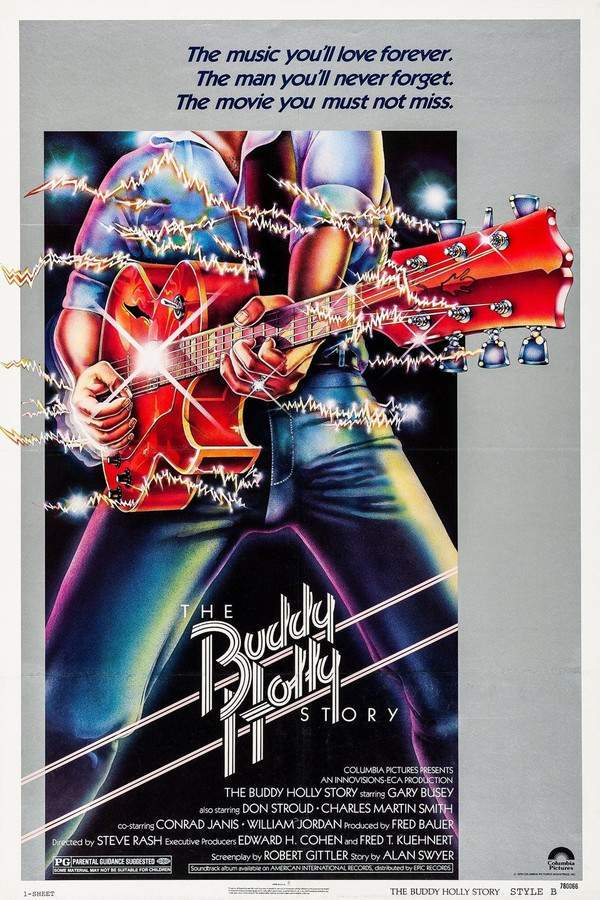
The Buddy Holly Story 1978

Directed by

Steve Rash
Made by

Columbia Pictures
The Buddy Holly Story Plot Summary
Read the complete plot summary and ending explained for The Buddy Holly Story (1978). From turning points to emotional moments, uncover what really happened and why it matters.
As the vibrant Texas landscape of 1956 bursts with the sounds of rock ‘n’ roll, Buddy Holly](/actor/charles-martin-smith) and his bandmates, Jesse Charles (drummer) and Ray Bob Simmons (bass player), known collectively as The Crickets, electrify a local roller rink with their dynamic performances. Their youthful energy, however, clashes with the expectations of the radio station’s sponsor, who had envisioned a more traditional country music atmosphere. The station manager, Riley, excitedly informs them that the vice president of Coral Records is eager to sign them and take them to a recording studio in Nashville, Tennessee.
Upon reaching the studio, tension arises from creative differences with the producers, leading Holly to make a bold decision to leave, unwilling to compromise his artistic integrity. Unbeknownst to the band, Riley had secretly sent a demo tape of their roller rink performance to music executive Ross Turner in New York City. The tape is mistakenly released as a master copy, propelling them into unexpected stardom. With this newfound fame, Holly embraces the chance to pursue his passion for music full-time.
When The Crickets meet with Turner in the bustling metropolis, what begins as resistance transforms into a partnership that allows Holly to create music on his own terms. Additionally, Sol Gittler books them for a performance at the legendary Apollo Theater in Harlem, mistakenly believing them to be a black group. Surprised by the arrival of three white Texans, he is initially hesitant to let them perform due to fears of a negative audience reaction. However, Holly highlights that Gittler specifically requested their presence for a week along with a guaranteed payment of $1,000. Reluctantly, Gittler agrees, making history as The Crickets become the first white act to perform at the Apollo Theater.
Though they face initial apprehension, Holly’s infectious music wins over the crowd, leading to their instant success. In the midst of this excitement, Holly meets Maria Elena Santiago, Turner’s charming secretary, and an undeniable chemistry brews between them. However, their romance faces challenges when her strict aunt disapproves of their relationship. Undeterred by these obstacles and believing in the power of love, Holly manages to win her over, leading to their marriage.
As their exhilarating two-year journey begins to cool, Ray Bob and Jesse feel a growing desire to return to their Texas roots, yearning for the familiar rhythms of the landscapes they once called home. In contrast, Holly remains steadfast in his wish to capitalize on his burgeoning fame, resisting the nostalgic pull despite pleas from his partners to return to Lubbock under The Crickets’ name. The emotional weight of their impending separation lingers heavily on Holly as he faces the daunting uncertainty of what lies ahead.
With the spotlight shining brighter than ever, Holly finds peace in songwriting, pouring his soul into the lyrics and melodies that flow from his heart. Yet, the pressure from his manager to hit the road at the height of their success compounds his insecurities. Amidst this turmoil, the news of Maria’s pregnancy brings a bright spot, filling him with joy and responsibility, encouraging him to return to the touring circuit.
Little does Holly realize the unforeseen fate that awaits him. On February 2, 1959, just moments before he was set to perform in Clear Lake, Iowa, the strains of continuous touring weigh heavily on him. With their tour bus incapacitated and no alternative mode of transport available, Holly opts for a private flight to Moorhead, Minnesota, joined by fellow musicians Ritchie Valens and The Big Bopper. As The Crickets reflect on their past experiences, a wave of nostalgia washes over them, and they long to reunite with Holly at his next destination.
As the final notes of “Not Fade Away” resonate through the venue, Holly bids an emotional farewell to his appreciative audience, blissfully unaware that this would be his ultimate performance. A poignant reminder lingers in the air: ”… and the rest is Rock ‘n Roll.”
The Buddy Holly Story Timeline
Follow the complete movie timeline of The Buddy Holly Story (1978) with every major event in chronological order. Great for understanding complex plots and story progression.
The Crickets' Roller Rink Performance
In 1956, Buddy Holly and his bandmates, known as The Crickets, electrify a local roller rink in Texas with their vibrant rock 'n' roll music. Their youthful energy captivates the audience, setting the stage for their future successes despite clashing with traditional music expectations.
Recording Contract Opportunity
Excitement erupts when the station manager, Riley, reveals that the vice president of Coral Records is eager to sign The Crickets. This opportunity marks a pivotal moment in their journey, indicating the potential for greater recognition in the music industry.
Creative Differences at the Studio
Upon arriving at the recording studio in Nashville, tension surfaces as Buddy Holly encounters creative differences with the producers. Prioritizing his artistic integrity, Holly makes the bold decision to leave, a significant turning point in his career.
Demo Tape Mistake
Unbeknownst to the band, Riley secretly sends a demo tape of their roller rink performance to music executive Ross Turner in New York City. Mistakenly released as a master copy, this tape catapults The Crickets into unexpected stardom and recognition.
Meeting with Ross Turner
The Crickets meet with music executive Ross Turner in New York, where initial resistance subsides into a promising partnership. This collaboration empowers Buddy Holly to create music on his own terms, igniting his creative passion.
Performance at the Apollo Theater
Gittler mistakenly books The Crickets for a performance at the legendary Apollo Theater in Harlem, initially fearing a negative audience reaction. However, when Holly highlights their guaranteed payment, Gittler reluctantly agrees, allowing them to make history as the first white act to perform there.
Winning Over the Apollo Crowd
Facing initial apprehension, The Crickets take the stage at the Apollo Theater. Holly's infectious music quickly wins over the audience, marking a significant success in their burgeoning career.
Blooms of Romance
During this whirlwind of success, Buddy Holly encounters Maria Elena Santiago, Turner's charming secretary, and sparks ignite between them. Their budding romance faces challenges from Maria's strict aunt, but Holly is determined to win her over.
Holly's Marriage
Against the odds, Buddy Holly successfully persuades Maria's aunt and eventually marries her. This union signifies a new chapter in Holly's life, intertwining his personal and professional journeys.
Desire to Return to Texas
As their exhilarating journey begins to cool, bandmates Ray Bob and Jesse express a growing longing to return to their Texas roots. Contrastingly, Holly remains fixated on his career, leading to tensions within the band.
Holly's Songwriting Peace
While navigating the pressures of fame, Buddy Holly finds solace in songwriting, channeling his emotions into meaningful lyrics. However, he also feels the weight of his manager pushing for constant touring.
Maria's Pregnancy
The announcement of Maria's pregnancy fills Holly with joy and sense of responsibility. This news motivates him to embrace the touring circuit, highlighting the intertwining of his personal and professional life.
The Fateful Flight
On February 2, 1959, just before a planned performance in Clear Lake, Iowa, Buddy Holly faces the mounting pressures of continuous touring. Opting for a private flight to Moorhead, Minnesota, he embarks on a journey that will lead to unforeseen tragedy.
Final Performance
As Holly performs 'Not Fade Away' to an appreciative audience, he basks in the joy of his career. Unbeknownst to him, this electrifying show will be his last, a poignant reminder of the fleeting nature of success.
The Legacy of Rock 'n Roll
With the final notes of the concert lingering, Holly's impact on music solidifies his legacy. His journey reflects the vibrant spirit of rock 'n' roll and serves as a powerful reminder of the profound effects of music on culture and life.
The Buddy Holly Story Characters
Explore all characters from The Buddy Holly Story (1978). Get detailed profiles with their roles, arcs, and key relationships explained.
Buddy Holly
Buddy Holly is portrayed as a passionate and innovative musician, dedicated to his craft. He is characterized by his artistic vision and determination to maintain creative control over his music, which leads him to confront industry challenges. His charming personality and resilience play a crucial role in crafting his impactful legacy.
Jesse Charles
Jesse Charles is depicted as the loyal drummer of The Crickets, who, while supportive, struggles with the pressures of impending fame. He represents the grounded side of the band, often yearning for their Texas roots amid the whirlwind of success. His friendship with Holly is central to his character development.
Ray Bob Simmons
Ray Bob Simmons plays the role of the steadfast bass player and a voice of reason within The Crickets. He exhibits a mix of ambition and nostalgia, caught between the excitement of success and a desire to return to their simpler beginnings. His character highlights the struggles artists face with fame's cost.
Maria Elena Santiago
Maria Elena Santiago emerges as a charming yet challenging romantic interest for Buddy Holly, whose relationship with him signifies the complexities of love amid the entertainment industry. She embodies resilience and charm, facing familial opposition yet reinforcing the emotional layers within Holly's life.
The Buddy Holly Story Settings
Learn where and when The Buddy Holly Story (1978) takes place. Explore the film’s settings, era, and how they shape the narrative.
Time period
1956-1959
Set in the late 1950s, this period was marked by the rise of rock 'n' roll, revolutionizing the music landscape. It was an era filled with youthful rebellion, vibrant performances, and significant cultural shifts, transforming how music was consumed and appreciated. This was a time when artists like Buddy Holly would lay the groundwork for future generations of musicians.
Location
Texas, Nashville, New York City, Harlem, Clear Lake, Iowa, Moorhead, Minnesota
The movie takes place primarily in Texas, where Buddy Holly and his band, The Crickets, energize the local music scene. Nashville serves as a crucial site for their recording ambitions. New York City and Harlem highlight the transition to fame and the cultural melting pot of the music industry. Lastly, Clear Lake, Iowa, and Moorhead, Minnesota, set the stage for the climactic moments of Holly's journey.
The Buddy Holly Story Themes
Discover the main themes in The Buddy Holly Story (1978). Analyze the deeper meanings, emotional layers, and social commentary behind the film.
🎶
Artistic Integrity
The theme of artistic integrity permeates the film as Buddy Holly faces struggles between commercial expectations and his passion for true music expression. His determination to stay true to himself shines through, especially when making pivotal decisions against industry pressures. This resonates deeply with the idea of remaining authentic in an evolving entertainment landscape.
❤️
Love and Relationships
Love plays a significant role in Holly's life, especially highlighted through his romance with Maria Elena Santiago. Their bond faces challenges and societal disapproval but ultimately thrives against the odds. The theme underscores the importance of connection and commitment, even amid personal and professional tumult.
🎤
Fame and Legacy
Fame and its associated pressures are central to Buddy Holly's journey, as he quickly transitions from local performer to a rock 'n' roll icon. The film explores the duality of success, presenting both the exhilarating highs and the devastating lows. Holly's drive to secure his legacy through music forms the crux of his story.

The Buddy Holly Story Spoiler-Free Summary
Discover the spoiler-free summary of The Buddy Holly Story (1978). Get a concise overview without any spoilers.
In the sweltering summer of 1956, the small towns of Texas pulse with a new, restless energy, and at its heart stands Buddy Holly, a restless guitarist with a voice that seems to carry the future on its breath. Beside him, the steady beat of Jesse on drums and the warm thrum of Ray Bob Simmons on bass form The Crickets, a trio whose chemistry feels both youthful and inevitable. Their music is louder than the radio‑station jukeboxes that still favor twangy country, and the trio’s electric performances quickly become the soundtrack of a generation hungry for something fresh.
The world they step into is one of smoky roller rinks, eager promoters, and record‑label executives who see a market in their raw sound—but only if it can be molded to fit existing molds. Buddy’s fierce commitment to artistic integrity clashes with the commercial expectations that surround him, setting up a tension between creative freedom and the allure of wider recognition. The band’s ambitions begin to pull them beyond the familiar Texas horizon, hinting at studio rooms in distant cities where the stakes grow higher with each chord.
Amid the rising buzz, Buddy meets Maria Elena Santiago, a secretary whose quick wit and quiet strength draw him into a romance that offers both solace and new complications. Their connection underscores the personal costs of a life lived on the edge of fame, as family ties, hometown longing, and the relentless drive to perfect his music pull him in opposite directions. The relationship adds a layer of tenderness to a story otherwise defined by ambition and the roar of a crowd.
Yet, as momentum builds, the trio finds themselves at a crossroads, balancing the intoxicating promise of national stardom against the pull of home and the fear of losing the very spark that set them apart. The film dances between bright, buzzing optimism and the quiet doubts that underlie every daring creative leap, leaving the audience eager to see whether Buddy’s relentless drive will carry him to the heights he imagines—or somewhere altogether unexpected.
Movies with Similar Twists and Themes
Uncover films that echo the narrative beats, emotional arcs, or dramatic twists of the one you're exploring. These recommendations are handpicked based on story depth, thematic resonance, and spoiler-worthy moments — perfect for fans who crave more of the same intrigue.

Featured on this page

What's After the Movie?
Not sure whether to stay after the credits? Find out!




Explore Our Movie Platform
New Movie Releases (2025)
Famous Movie Actors
Top Film Production Studios
Movie Plot Summaries & Endings
Major Movie Awards & Winners
Best Concert Films & Music Documentaries
Movie Collections and Curated Lists
© 2025 What's After the Movie. All rights reserved.