
Joy 2024

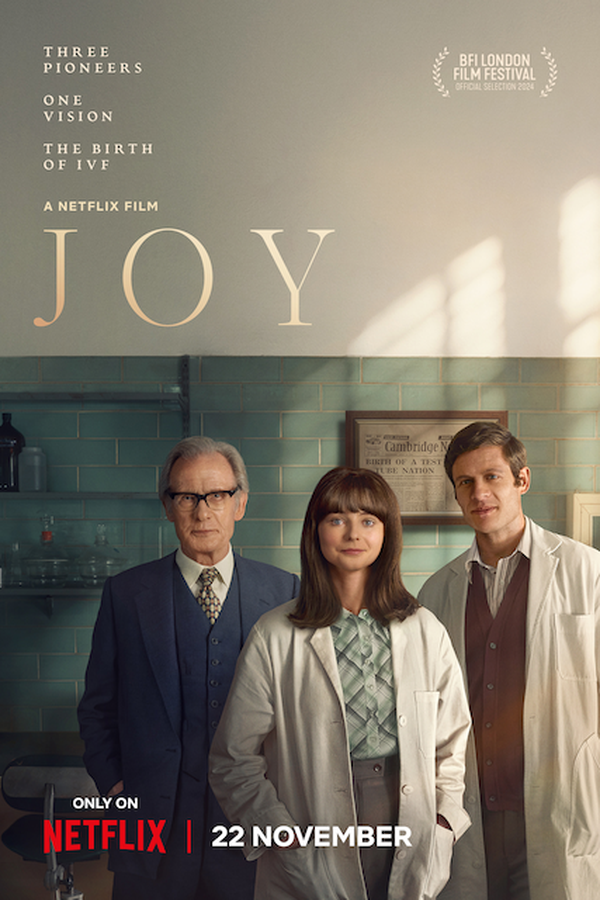
This film portrays three pioneering individuals – a nurse, a scientist, and a surgeon – who face considerable resistance from the church, government, media, and medical community as they strive to achieve the birth of the world's first baby conceived through in vitro fertilization, Louise Joy Brown.

Does Joy have end credit scenes?
No!
Joy does not have end credit scenes. You can leave when the credits roll.
Meet the Full Cast and Actors of Joy
Explore the complete cast of Joy, including both lead and supporting actors. Learn who plays each character, discover their past roles and achievements, and find out what makes this ensemble cast stand out in the world of film and television.







External Links and Streaming Options
Discover where to watch Joy online, including streaming platforms, rental options, and official sources. Compare reviews, ratings, and in-depth movie information across sites like IMDb, TMDb, Wikipedia or Rotten Tomatoes.












Ratings and Reviews for Joy
See how Joy is rated across major platforms like IMDb, Metacritic, and TMDb. Compare audience scores and critic reviews to understand where Joy stands among top-rated movies in its genre.

The Movie Echo Score
The film exhibits solid strengths in character portrayal and emotional engagement but balances them with a conventional narrative and a modest visual approach. Critics praise the lead performance and the heartwarming, feel-good delivery, although some note pacing issues and a made-for-TV sensibility. While its craftsmanship and sensory elements rarely feel groundbreaking, the story’s uplifting core and competent execution deliver a consistently pleasant experience.
The Movie Echo Score Breakdown for Joy

Art & Craft
The direction and production design are serviceable without standing out as particularly innovative. In terms of cinematography, the film conveys period flavor effectively but seldom ventures beyond a straightforward presentation. Editing flows smoothly but retains a no-frills quality. Overall, the art and craft elements remain competent yet rarely striking.

Character & Emotion
Characterizations drive the film through strong lead performances and genuine emotional beats. When it comes to acting, the cast delivers nuanced portrayals that elevate standard material. Emotional resonance is anchored by moments of warmth and compassion, though some supporting figures feel underdeveloped. Ultimately, the character work remains the film’s most compelling asset.

Story & Flow
Story coherence and thematic intention are clear, presenting an uplifting account of scientific perseverance. Plot pacing fluctuates between deliberate reflection and modest momentum, which may feel slow to some viewers. Originality is tempered by a conventional structure, yet the narrative’s message of human ingenuity and perseverance sustains engagement. Overall, the story offers earnest appeal.

Sensory Experience
Sensory elements support the film’s nostalgic tone without drawing undue attention. In terms of soundtrack and sound design, the score underscores emotional turns with subtlety rather than flair. Visual style achieves a cohesive period aesthetic but favors restraint over bold cinematographic choices. As a result, the sensory experience is polished yet quietly unobtrusive.

Rewatch Factor
Rewatch value is moderate, anchored by the film’s heartwarming core and informative subject matter. The enduring appeal of its true-story foundation sustains interest, and subsequent viewings may reinforce appreciation for the performances. However, familiarity with the straightforward narrative and measured pacing could lessen the sense of discovery. Overall, the film offers respectable replay potential.

62
Metascore
6.3
User Score


89%
TOMATOMETER

88%
User Score

/10
IMDb Rating

68
%
User Score

3.5
From 32 fan ratings

3.78/5
From 74 fan ratings
Take the Ultimate Joy Movie Quiz
Challenge your knowledge of Joy with this fun and interactive movie quiz. Test yourself on key plot points, iconic characters, hidden details, and memorable moments to see how well you really know the film.
Joy (2024) Movie Quiz: Test your knowledge of the 2024 film *Joy*, which chronicles the pioneering journey toward the first test‑tube baby.
What is the name of the nurse who becomes the lab manager?
Full Plot Summary and Ending Explained for Joy
Read the complete plot summary of Joy, including all major events, twists, and the full ending explained in detail. Explore key characters, themes, hidden meanings, and everything you need to understand the story from beginning to end.
In 1968, Nurse Jean Purdy [Thomasin McKenzie] is hired at the University of Cambridge for a lab manager post by Dr Bob Edwards [James Norton], a scientist determined to push the boundaries of reproduction research. Together, they recruit a pioneering obstetrician and surgeon, Patrick Steptoe [Bill Nighy], to join their work in infertility treatment, with the bold aim of developing a procedure that could become in vitro fertilisation. Yet from the start, Patrick cautions that their path will meet resistance from government, church, and a skeptical public, even as their shared belief in progress drives them forward.
Jean and her family live within a tightly knit community of faith. They are regular churchgoers, and their close relationship with their vicar, Reverend Paulson [Robert Wilfort], anchors their moral world even as the team pushes forward into uncharted territory. The pair’s scientific ambitions hit a rough road: funding is scarce, and Jean and Robert must commute to Oldham four hours a day to keep their research moving. Robert explains their early work with small rodents to show progress, while the team quietly nudges toward a day they hope will redefine fertility.
By the next year, the team fertilises their first human ovum, a milestone that raises excitement and scrutiny in equal measure. The pace of discovery attracts attention—especially from the media—with The Daily Mirror dubbing Robert the nickname Dr. Frankenstein as public curiosity and fear grow in tandem. The success brings new tensions with Jean’s family, particularly her mother, who worries that their research is playing God. The conflict spills into Jean’s world: she feels pushed to the outside by both her church community and her own kin, and the emotional strain begins to show in how she relates to the women volunteering for their study.
Matters inside the clinic become more personal as the researchers pursue a meaningful connection with the women who participate in the trials. Matron Muriel [Tanya Moodie] challenges Jean’s sometimes clinical approach, reminding her that the participants deserve care and dignity. Meanwhile, the devotion to a larger goal presses on the team, even as Jean grapples with her own endometriosis and the implications it has for her life and work. There are moments when personal faith and scientific ambition clash, and the team must navigate the ethical landscape of offering women safer choices while contending with the fear of unknown outcomes.
Towards 1971, the team makes a formal appeal for funding to the Medical Research Council, arguing that their work could change countless lives. The request is rejected, and disappointment settles in as they ride the train home, weighed down by frustration but resolved to push on. In conversations that reveal growing personal stakes, Jean opens up about how deeply she is invested in the project, and Patrick listens, offering support while acknowledging the toll the research takes on their relationships. Arun [Rish Shah], the lab’s eager assistant, shares a moment of personal connection with Jean, hinting at a shared future that the team’s work complicates rather than clarifies.
In early 1973, after another difficult television appearance, the researchers begin implanting embryos in a few of the women. The pregnancies fail in different ways, and by September every attempt ends in disappointment. When a batch of experiments is found to have contaminated paraffin, the team’s confidence falters. The setback becomes a turning point: Jean quits to care for her dying mother as Robert’s faith in their path wavers. The lab is shut down during her absence, and the silence that follows speaks to the fragility of a dream built on risk and devotion.
A year later, Jean encounters Arun again, now a new father, who hints at the possibility of moving their lives forward despite the closure. She confronts Robert, who argues that her decision to quit transformed the course of the project as much as the setbacks did. The loss of her mother compounds Jean’s exhaustion, yet the two scientists find renewed purpose in the memories of their earlier breakthroughs and the enduring belief that they owe the women a chance at motherhood.
At the funeral, Patrick Steptoe and Muriel attend, and a rested, resolute Jean experiences a turning point. She decides to resume the study by tracking each participant’s natural cycle—an approach that reframes their work as a women-centered, biologically guided process rather than a single pursuit of a single outcome. In the summer of 1978, their revised method yields a breakthrough: the first test-tube baby, whom Robert names Joy. The achievement marks a historic moment, yet the story closes with a bittersweet note about the human costs behind scientific triumph.
The epilogue reveals the lasting consequences: Jean Purdy passes away from cancer at 39, and Robert Edwards is later recognized with the Nobel Prize in 2010 for the collaborative work that, with Patrick Steptoe, opened a new era in reproductive medicine. Through joy and loss, the film honors the quiet resilience of the people who carried a controversial dream to a wider world, forever changing how science, faith, and personal life intersect on the path to new possibilities.

Watch Trailers, Clips & Behind-the-Scenes for Joy
Watch official trailers, exclusive clips, cast interviews, and behind-the-scenes footage from Joy. Dive deeper into the making of the film, its standout moments, and key production insights.
Joy Themes and Keywords
Discover the central themes, ideas, and keywords that define the movie’s story, tone, and message. Analyze the film’s deeper meanings, genre influences, and recurring concepts.
Joy Other Names and Titles
Explore the various alternative titles, translations, and other names used for Joy across different regions and languages. Understand how the film is marketed and recognized worldwide.
Articles, Reviews & Explainers About Joy
Stay updated on Joy with in-depth articles, critical reviews, and ending explainers. Explore hidden meanings, major themes, and expert insights into the film’s story and impact.

Similar Movies To Joy You Should Know About
Browse a curated list of movies similar in genre, tone, characters, or story structure. Discover new titles like the one you're watching, perfect for fans of related plots, vibes, or cinematic styles.






Quick Links: Summary, Cast, Ratings, More

What's After the Movie?
Not sure whether to stay after the credits? Find out!




Explore Our Movie Platform
New Movie Releases (2025)
Famous Movie Actors
Top Film Production Studios
Movie Plot Summaries & Endings
Major Movie Awards & Winners
Best Concert Films & Music Documentaries
Movie Collections and Curated Lists
© 2025 What's After the Movie. All rights reserved.