
Miranda's Victim 2023

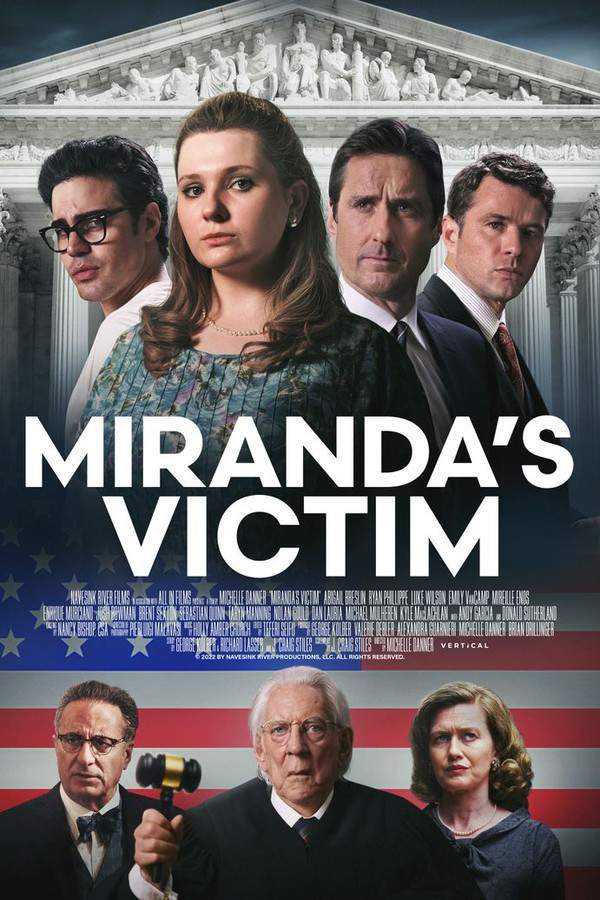
In 1963, the brutal assault and kidnapping of 18-year-old Trish Weir sends shockwaves through the community. Ernesto Miranda, her attacker, unexpectedly confesses to the crime without legal representation, leading to a quick conviction and a two-year sentence. However, the initial verdict is overturned, prompting a determined prosecutor, played by Luke Wilson, to relentlessly pursue justice and uncover the full truth behind the case.


Does Miranda's Victim have end credit scenes?
No!
Miranda's Victim does not have end credit scenes. You can leave when the credits roll.
Meet the Full Cast and Actors of Miranda's Victim
Explore the complete cast of Miranda's Victim, including both lead and supporting actors. Learn who plays each character, discover their past roles and achievements, and find out what makes this ensemble cast stand out in the world of film and television.

Andy Garcia
Alvin Moore

Emily VanCamp
Ann Weir

Abigail Breslin
Trish Weir

Luke Wilson
Lawrence Turoff

Donald Sutherland
Judge Wren

Ryan Phillippe
John Flynn

Enrique Murciano
Detective Cooley

Kyle MacLachlan
Chief Justice Earl Warren

Taryn Manning
Twila Hoffman

Will Fitz

Mireille Enos
Zeola Weir
Dan Lauria
Dr. Crawford
Brent Sexton
Sergeant Nealis
Najah Bradley
Secretary

James Healy Jr.
Judge
Sebastian Quinn
Ernesto Miranda
Nolan Gould
James Valenti
Josh Bowman
Charles
Rocío de la Grana
Brian Colin Foley
External Links and Streaming Options
Discover where to watch Miranda's Victim online, including streaming platforms, rental options, and official sources. Compare reviews, ratings, and in-depth movie information across sites like IMDb, TMDb, Wikipedia or Rotten Tomatoes.










Ratings and Reviews for Miranda's Victim
See how Miranda's Victim is rated across major platforms like IMDb, Metacritic, and TMDb. Compare audience scores and critic reviews to understand where Miranda's Victim stands among top-rated movies in its genre.

The Movie Echo Score
Miranda's Victim garners a largely positive reception, praised for its thematic relevance and competent execution. Critics highlight the film's powerful direction and emotionally resonant performances, while audiences commend its educational value and engaging storytelling. Minor criticisms focus on pacing and length, suggesting occasional narrative drag. Overall, the consensus reflects a strong, if not flawless, impact that positions the film as a noteworthy documentary drama.
The Movie Echo Score Breakdown for Miranda's Victim

Art & Craft
Direction and visual composition receive commendation for their measured poise and effective storytelling. Critics note Danner's ability to build tension with finesse, while users appreciate the clear cinematography and purposeful editing. There are few remarks on technical shortcomings, aside from a brief comment on runtime excess. In sum, the film’s artful elements are judged as a significant strength.

Character & Emotion
Acting performances are consistently praised across both critic and user commentary. Abigail Breslin’s portrayal, along with the ensemble cast, is described as nuanced and compelling, adding emotional weight to the narrative. Reviewers emphasize the authenticity of the portrayals and the ensemble’s chemistry. No substantive criticism of character work emerges, indicating that acting is a primary asset of the film.

Story & Flow
The narrative is lauded for its informative and engaging recounting of the Miranda rights origins. Critics describe the storytelling as convincing and the plot as historically significant. Some users note a tendency toward excessive length, hinting at pacing issues. Nevertheless, the film’s structure and originality sustain audience interest, making the story a largely effective component.

Sensory Experience
Sensory elements such as visuals and music garner positive remarks, with users highlighting vivid imagery and a score that counters potential dullness. While the soundtrack is appreciated for its supportive role, few detailed critiques of sound design appear. Overall, the sensory experience is deemed competent and complementary, though not as pronounced as the film’s other strengths.

Rewatch Factor
Rewatch potential is reflected in comments about the film’s educational value and lasting relevance. Critics and users alike recommend the documentary for future viewings, noting its importance and emotional resonance. Some viewers describe it as a hidden gem that invites repeated engagement. Although rewatch appeal is strong, it is tempered by remarks on length, placing this factor in the upper-mid range.


82%
TOMATOMETER

90%
User Score

6.7 /10
IMDb Rating

67
%
User Score

3.1

0.00/5
Take the Ultimate Miranda's Victim Movie Quiz
Challenge your knowledge of Miranda's Victim with this fun and interactive movie quiz. Test yourself on key plot points, iconic characters, hidden details, and memorable moments to see how well you really know the film.
Miranda's Victim Quiz: Test your knowledge on the film 'Miranda's Victim' and its powerful story surrounding the events that led to the Miranda Ruling.
What year does the film 'Miranda's Victim' begin?
Full Plot Summary and Ending Explained for Miranda's Victim
Read the complete plot summary of Miranda's Victim, including all major events, twists, and the full ending explained in detail. Explore key characters, themes, hidden meanings, and everything you need to understand the story from beginning to end.
In June 1966, new mother and wife Trish Weir is taken aback by the Supreme Court’s decision to enact the Miranda Ruling. This ruling states that any evidence obtained from a criminal suspect without first delivering what is known as the “Miranda warning” is to be considered inadmissible in court, a situation that poses a significant threat to her quest for justice.
Flashing back three years prior, we meet a young and shy Trish, who at the time is an 18-year-old with dreams of her future, riding in the car with her mother, Zeola. On their way to work at a cinema, the projectionist, Jimmy, suggests they catch the late bus home together, and they make plans to meet before her shift on Saturday.
However, tragedy strikes later that night when a shaken and distraught Trish returns home after a horrific incident. Ann, her initially stern older sister, senses something is amiss and rushes her to the doctor at 4 a.m. to seek evidence of rape. When they return, Trish goes to bed while Ann breaks the news to their parents, Zeola and Paul. Instead of showing understanding, Zeola expresses sorrow over losing Trish’s innocence, fearing it might hinder her daughter’s opportunities for a future career in secretarial school. She expresses doubts that the police will take her seriously.
The following morning, instead of offering genuine support, Zeola suggests that Trish consider “solutions” to the incident, including coercing the perpetrator into marriage or avoiding police involvement altogether. Disturbed by her mother’s callous attitude, Trish insists she must act to prevent this man from hurting others, but Zeola continues to express her belief that justice will not be served and that Trish will be labeled as “damaged goods.”
The day after the incident, tensions rise at the police station. Trish is determined to file charges, while Zeola tries to persuade her otherwise, creating a split in family loyalties. Despite her mother’s interjections, Trish recounts the harrowing details of what happened: after boarding the bus at midnight, she was forcibly taken by her assailant, who bound her hands and drove her into the desert, where he raped her at knifepoint.
After a week, Trish returns to her job, only to find Jimmy avoiding her, likely due to the ongoing police investigation. Meanwhile, Paul notes a suspicious sedan near the bus stop and manages to write down the license plate number. This leads detectives to Twila Hoffman, who has connections to the suspect, Ernesto Miranda. Upon investigating Twila’s home, they find evidence that ties Ernesto to the crime, after which he agrees to cooperate with the police.
At a lineup, both Trish and another victim, Barbara, identify Ernesto as their attacker, confirming his involvement in the assault. Trish specifically requests he wear glasses and speaks, which aids her identification and helps the police secure a confession.
During the 1963 trial, Trish stands firm and identifies Ernesto as the man who raped her. The defense attempts to create doubt about her testimony, but the jury ultimately finds him guilty. Amid these developments, Trish marries Charles and welcomes a new baby, while Ernesto’s conviction faces scrutiny that prompts an appeal to the Arizona Supreme Court. A lawyer from the ACLU, John Flynn, champions the retrial that is granted in 1967.
As the retrial approaches, Twila, who has distanced herself from Ernesto, steps forward to testify against him. However, Trish is hesitant to take the stand again, caught in a controlling marriage with Charles, who becomes aggressive when he learns about the prosecutor’s visit concerning the case.
Charles ultimately faces the consequences of his reckless behavior and is pulled over for driving while intoxicated. Here, the prosecutor, Lawrence Turoff, emphasizes to him that Trish is one of the few courageous victims willing to press charges, further complicating their already tumultuous relationship. At the trial, Judge Wren stresses the importance of confidentiality regarding Trish’s identity.
Twila’s testimony becomes pivotal for the prosecution as it is deemed admissible. During her time on the stand, she reveals that Ernesto confessed to her while they were together in jail. When Trish returns to testify, she openly shares her traumatic experience, confirming the act of rape while stating she had feared for her life.
In the end, Judge Wren and the jury unanimously find Ernesto guilty. After serving eight years in prison, he attempts to profit from his notoriety by selling autographed copies of the Miranda Warning. His story takes a fatal turn after a night of poker, where he meets his demise.

Watch Trailers, Clips & Behind-the-Scenes for Miranda's Victim
Watch official trailers, exclusive clips, cast interviews, and behind-the-scenes footage from Miranda's Victim. Dive deeper into the making of the film, its standout moments, and key production insights.
Miranda's Victim Themes and Keywords
Discover the central themes, ideas, and keywords that define the movie’s story, tone, and message. Analyze the film’s deeper meanings, genre influences, and recurring concepts.
Miranda's Victim Other Names and Titles
Explore the various alternative titles, translations, and other names used for Miranda's Victim across different regions and languages. Understand how the film is marketed and recognized worldwide.
Similar Movies To Miranda's Victim You Should Know About
Browse a curated list of movies similar in genre, tone, characters, or story structure. Discover new titles like the one you're watching, perfect for fans of related plots, vibes, or cinematic styles.








Quick Links: Summary, Cast, Ratings, More

What's After the Movie?
Not sure whether to stay after the credits? Find out!




Explore Our Movie Platform
New Movie Releases (2025)
Famous Movie Actors
Top Film Production Studios
Movie Plot Summaries & Endings
Major Movie Awards & Winners
Best Concert Films & Music Documentaries
Movie Collections and Curated Lists
© 2025 What's After the Movie. All rights reserved.