
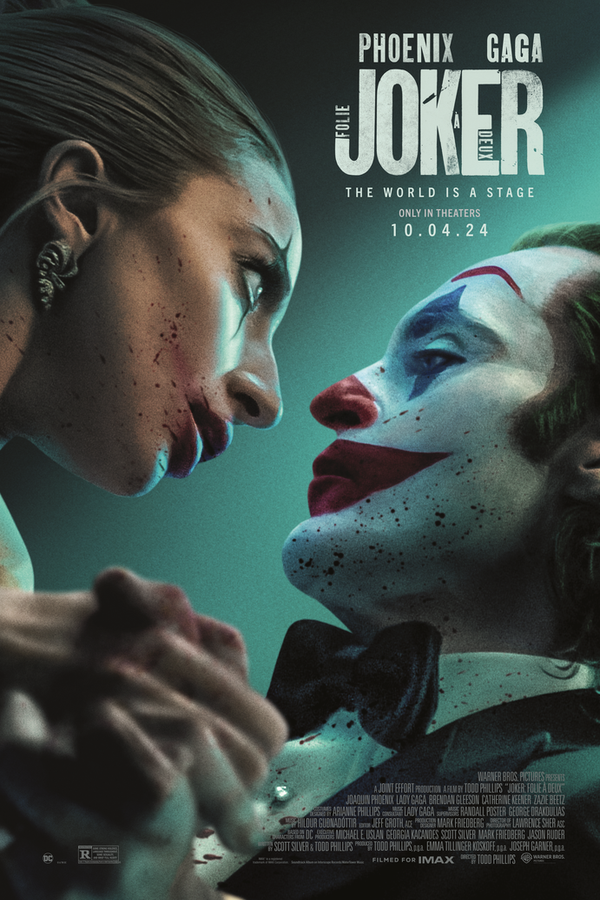
Joker: Folie à Deux 2024

Directed by

Todd Phillips
Made by

DC Entertainment
Joker: Folie à Deux Plot Summary
Read the complete plot summary and ending explained for Joker: Folie à Deux (2024). From turning points to emotional moments, uncover what really happened and why it matters.
In a striking animated sequence, the Joker finds himself replaced by his own shadow during a singing number for a television show, only to be left behind on stage as three policemen arrive and brutally assault him.
Now in custody at Arkham State Hospital, Arthur Fleck is awaiting trial for crimes he committed two years earlier. His lawyer, Maryanne Stewart, is preparing to argue that Arthur suffers from dissociative identity disorder, attributing his violent actions to the dark persona of the Joker. At a music therapy session in the hospital’s B ward, Arthur encounters Harleen “Lee” Quinzel, played by Lady Gaga. Lee shares her tragic backstory, revealing her abusive childhood and how she was admitted after a devastating incident involving her parents’ home. Intriguingly, she also expresses admiration for Arthur’s Joker persona and his notorious deeds.
As they watch a screening of The Band Wagon, chaos ensues when Lee ignites a fire, leading to their capture while attempting to escape. This results in Arthur being placed in solitary confinement. Lee, visiting him, shares her plans to be released in order to distance herself from his influence but promises to support him during his trial, culminating in a brief intimate encounter. During an interview with television host Paddy Meyers, Arthur serenades Lee through the screen, deepening her infatuation with him.
On the trial’s day, Assistant District Attorney Harvey Dent presents witnesses who invalidate Arthur’s insanity claims. In a surprising twist, Maryanne unveils Lee’s true identity as a psychiatry student from the Upper West Side whose father is very much alive. She had voluntarily committed to Arkham and had never burned down her childhood home. Confronted by Arthur, Lee admits her fabrications were efforts to bond with him but drops the bombshell that she is pregnant and has moved into his former apartment building, wishing to forge a life together.
The trial takes a dramatic turn as Arthur dismisses Maryanne, opting to represent himself. After hearing testimonies from Gary Puddles Leigh Gill and Sophie Dumond Zazie Beetz, Arthur is noticeably shaken and offers no defense. Instead, during his speech, he ridicules the Arkham guards and hints at the abuse he has suffered. Sent back to Arkham, he endures a horrific assault by head guard Jackie Sullivan and others, culminating in the death of his friend Ricky Jacob Lofland.
In a heart-wrenching closing statement in court, Arthur resolutely renounces his Joker identity, taking accountability for his actions. This revelation angers Lee, prompting her to leave his side. The ensuing verdict finds Arthur guilty of first-degree murder, and as the foreman announces the verdict, a car bomb detonates outside the courthouse, causing mass casualties and leaving Dent severely scarred.
In the ensuing chaos, Arthur’s followers facilitate his escape. Wandering through Gotham City, he finds Lee outside his former residence, but she turns him away for renouncing the Joker. As Arthur is recaptured by the police, he faces betrayal from a young inmate who approaches him with a joke before brutally stabbing him. As Arthur succumbs to his injuries, the assailant laughs maniacally, carving a haunting smile on his own face, adding a sinister twist to Arthur’s tragic story.
Joker: Folie à Deux Timeline
Follow the complete movie timeline of Joker: Folie à Deux (2024) with every major event in chronological order. Great for understanding complex plots and story progression.
Joker's Onstage Assault
During a television show performance, the Joker unexpectedly finds himself replaced by his own shadow while singing. Three policemen arrive shortly after and brutally assault him, leaving him bewildered and injured on stage.
Arthur's Custody at Arkham
Arthur Fleck is now in custody at Arkham State Hospital, awaiting trial for his prior violent actions committed two years ago. His lawyer, Maryanne Stewart, is preparing a defense centered around his dissociative identity disorder, which connects him to his violent alter ego, the Joker.
Meeting Harleen 'Lee' Quinzel
Arthur meets Harleen 'Lee' Quinzel during a music therapy session in Arkham’s B ward. Lee reveals her tragic childhood and expresses admiration for the Joker, hinting at a dark fascination with his notorious deeds.
Chaos During the Screening
While watching a screening of *The Band Wagon*, chaos ensues as Lee sets a fire, leading to their capture during an attempted escape. This act results in Arthur being confined to solitary, raising the stakes in their tumultuous relationship.
Lee's Promise of Support
Although Lee plans to separate herself from Arthur's influence, she promises to support him during his trial. Their connection deepens with a brief intimate encounter, showcasing the complexity of their relationship.
Arthur Serenades Lee
In an interview with television host Paddy Meyers, Arthur serenades Lee through the screen, further intensifying her infatuation with him. This moment highlights their bond and the depth of Lee’s admiration for Arthur's alter ego.
Trial Begins
On the day of the trial, Assistant District Attorney Harvey Dent presents witnesses who contradict Arthur's claims of insanity. This crucial moment sets the stage for a dramatic courtroom battle, stirring tensions and expectations.
Lee's True Identity Revealed
In a shocking revelation, Maryanne unveils Lee’s true identity as a psychiatry student whose father is alive. This exposes the lies Lee told Arthur about her past and complicates their relationship as the trial progresses.
Arthur's Descent
Choosing to represent himself, Arthur hears testimonies from Gary Puddles and Sophie Dumond that deeply shake him. Instead of offering a defense, his speech ridicules the Arkham guards and hints at the abuse he has faced.
Brutal Assault in Arkham
After the trial, Arthur is sent back to Arkham, where he suffers a brutal assault from the head guard and others. This barbaric act culminates in the tragic death of his friend Ricky, showcasing the harsh reality of life in prison.
Arthur's Renunciation
In a poignant closing statement, Arthur rejects his Joker identity and takes accountability for his actions. This renunciation enrages Lee, leading to her departure and foreshadowing the chaos to follow.
Guilty Verdict and Bombing
The courtroom reaches its climax when Arthur is found guilty of first-degree murder. Just as the verdict is read, a car bomb detonates outside, causing mass casualties and leaving Assistant District Attorney Harvey Dent severely scarred.
Arthur's Escape
In the chaos following the bombing, Arthur’s followers help him escape from the courthouse. This moment marks a significant turning point, reigniting his infamous legacy as the Joker.
Confrontation with Lee
Arthur finds Lee outside his former residence, but she turns him away, upset over his rejection of the Joker persona. This heartbreaking encounter highlights the emotional turmoil in Arthur's life.
Final Betrayal and Death
As Arthur is recaptured by the police, he faces betrayal from a young inmate who approaches him with a joke before stabbing him. In his final moments, Arthur succumbs to his injuries, leaving a haunting image with the assailant laughing maniacally.
Joker: Folie à Deux Characters
Explore all characters from Joker: Folie à Deux (2024). Get detailed profiles with their roles, arcs, and key relationships explained.
Arthur Fleck
Arthur is a deeply troubled man, battling mental illness and societal rejection as he navigates life as the Joker. Throughout the film, he exhibits layers of vulnerability and rage, revealing a complex character that elicits both empathy and revulsion. His evolution is marked by poignant relationships that culminate in tragedy.
Maryanne Stewart
Maryanne is Arthur's lawyer, fighting to establish a narrative around his actions that considers his mental health struggles. She is depicted as professional yet challenged by the complexities of Arthur's case, representing the legal system's attempts to understand and manage mental illness.
Lee Quinzel
Lee is a complex character who becomes infatuated with Arthur and embodies the blurred lines between obsession and genuine connection. Her own tragic backstory adds depth to her character, and her interactions with Arthur reveal both a supportive influence and a layer of manipulation.
Harvey Dent
Harvey Dent is portrayed as the Assistant District Attorney determined to challenge Arthur's insanity plea. His character represents the legal opposition Arthur faces, providing insight into the judicial system's views on mental illness and crime.
Paddy Meyers
Paddy is a television host who serves as a catalyst for Arthur's public unveiling. His portrayals contribute to the media's impact on societal views of criminality and mental health, reflecting the complex relationship between public perception and personal reality.
Joker: Folie à Deux Settings
Learn where and when Joker: Folie à Deux (2024) takes place. Explore the film’s settings, era, and how they shape the narrative.
Time period
The story unfolds in a modern day setting, reflecting contemporary issues such as mental health, crime, and media influence. The trial and its events resonate with themes relevant to the present societal landscape, shedding light on the stigma surrounding mental illness and accountability.
Location
Arkham State Hospital, Gotham City
Arkham State Hospital is a notorious psychiatric facility known for housing the criminally insane. It serves as a backdrop for Arthur Fleck's harrowing journey as he faces inner demons and the societal responses to his violent actions. Gotham City, the larger setting, is famous for its dark and gritty atmosphere, undercurrents of chaos, and its complex relationship with law and order.
Joker: Folie à Deux Themes
Discover the main themes in Joker: Folie à Deux (2024). Analyze the deeper meanings, emotional layers, and social commentary behind the film.
😈
Duality
The film explores the duality of identity through Arthur's struggle with his Joker persona, which contrasts sharply with his desperate desire for acceptance and normalcy. This theme is embodied in his interactions with Lee and his eventual rejection of the Joker identity, showcasing the internal conflict between his chaotic nature and the remnants of his humanity.
💔
Tragedy
Tragedy permeates the narrative, highlighted by Arthur's troubled past and the brutal realities he faces in the present. His relationships are marred by loss, betrayal, and the consequences of societal neglect, ultimately leading to a heartbreaking demise that emphasizes the tragic consequences of his life choices.
🔥
Chaos
Chaos reigns throughout the film, from the fiery escape attempt to the courtroom upheaval and subsequent car bomb detonation. This theme underscores the unpredictable nature of Arthur's life and the ripple effects of his actions on Gotham City, catalyzing both destruction and a twisted sense of liberation.

Joker: Folie à Deux Ending Explained
Unravel the ending of Joker: Folie à Deux (2024) with our detailed explanation. Understand the final scenes, character fates, and unresolved questions.
At the end of Joker: Folie à Deux, Arthur’s journey reaches a tragic and brutal climax. After his trial, where he tries to claim innocence and starts to embrace his Joker persona fully, a car bomb sets him free in a moment of chaos. Overjoyed at what he perceives as a new beginning with Lee, who he believes is genuinely in love with him and pregnant with his child, he eagerly awaits a future they could share. However, Lee’s true intentions are far from Arthur’s hopes—she has fabricated her feelings and the pregnancy to manipulate him. When she leaves him, Arthur’s illusion of love and companionship shatters, leaving him devastated.
As Arthur’s hopes for a new life fade, he innocently walks through Arkham, still longing for Lee’s return and unaware that her departure is final. His belief that they might escape together keeps him hopeful, but reality hits hard when a fellow inmate, obsessed with Arthur and disappointed by his cowering and begging during the trial, turns violently against him. In a savage act, the inmate stabs Arthur to death, symbolizing how the monster he became ultimately devoured him. The inmate’s mutilation of his own face in a Glasgow smile echoes the Joker’s chaotic identity, sealing Arthur’s fate as a victim of his own creation.
Arthur’s death signifies that the chaos and madness he embodied have finally consumed him, just as the Joker’s legend persists as an endless cycle of suffering and violence. His tragic end underscores how the character of Joker embodies the destructive cycle of mental illness, societal neglect, and the destructive power of chaos. In the end, the Joker’s legacy was passed on to another broken soul, emphasizing that chaos is never truly silenced; it simply transforms and persists through those who are lost and manipulated by it. Arthur’s story closes with a haunting reminder that sometimes, the monster we create ends up destroying us.
Joker: Folie à Deux Spoiler-Free Summary
Discover the spoiler-free summary of Joker: Folie à Deux (2024). Get a concise overview without any spoilers.
In the infamous streets of Gotham, the confines of Arkham State Hospital become a bleak stage where reality blurs with performance. Arthur Fleck sits behind the infamous mask of the Joker, his identity frayed by the weight of past deeds and an uncertain future. Awaiting a trial that could finally define—or condemn—him, he is surrounded by cold corridors, whispered rumors, and an undercurrent of desperate hope that flickers whenever a stray melody breaks the silence.
Within the asylum’s B ward, a hushed music‑therapy program offers a fragile sanctuary from the oppressive gray. It is here that Harleen “Lee” Quinzel arrives, a patient whose own trauma mirrors the darkness that haunts Arthur. Their connection is forged through shared songs and a raw, unspoken yearning for something beyond the walls that hold them. The duo’s tentative bond hints at a possible redemption through art, even as the institutional atmosphere constantly reminds them of the shadows lurking in every corner.
Outside the institution, the legal machinery prepares to dissect Arthur’s mind. His lawyer, Maryanne Stewart, is poised to argue that the Joker persona is a fractured alter ego, a defense that teeters between clinical analysis and theatrical spectacle. Meanwhile, the city’s power brokers, including the ambitious district attorney Harvey Dent, loom as looming figures whose decisions will shape the narrative of chaos and order. These forces converge in a mood that feels both claustrophobic and grandiose, echoing the stark contrast between Arkham’s sterile confines and Gotham’s neon‑lit madness.
The film swirls with a haunting blend of gritty realism and stylized surrealism, punctuated by haunting musical interludes that underscore the characters’ inner turmoil. Its tone oscillates between melancholy introspection and darkly comic flair, inviting the audience to wonder whether a broken soul can ever truly escape the echo of his own laughter. The stage is set, the players are in place, and the story promises a tense dance between identity, desire, and the ever‑present specter of madness.
Movies with Similar Twists and Themes
Uncover films that echo the narrative beats, emotional arcs, or dramatic twists of the one you're exploring. These recommendations are handpicked based on story depth, thematic resonance, and spoiler-worthy moments — perfect for fans who crave more of the same intrigue.





Featured on this page

What's After the Movie?
Not sure whether to stay after the credits? Find out!




Explore Our Movie Platform
New Movie Releases (2026)
Famous Movie Actors
Top Film Production Studios
Movie Plot Summaries & Endings
Major Movie Awards & Winners
Best Concert Films & Music Documentaries
Movie Collections and Curated Lists
© 2026 What's After the Movie. All rights reserved.